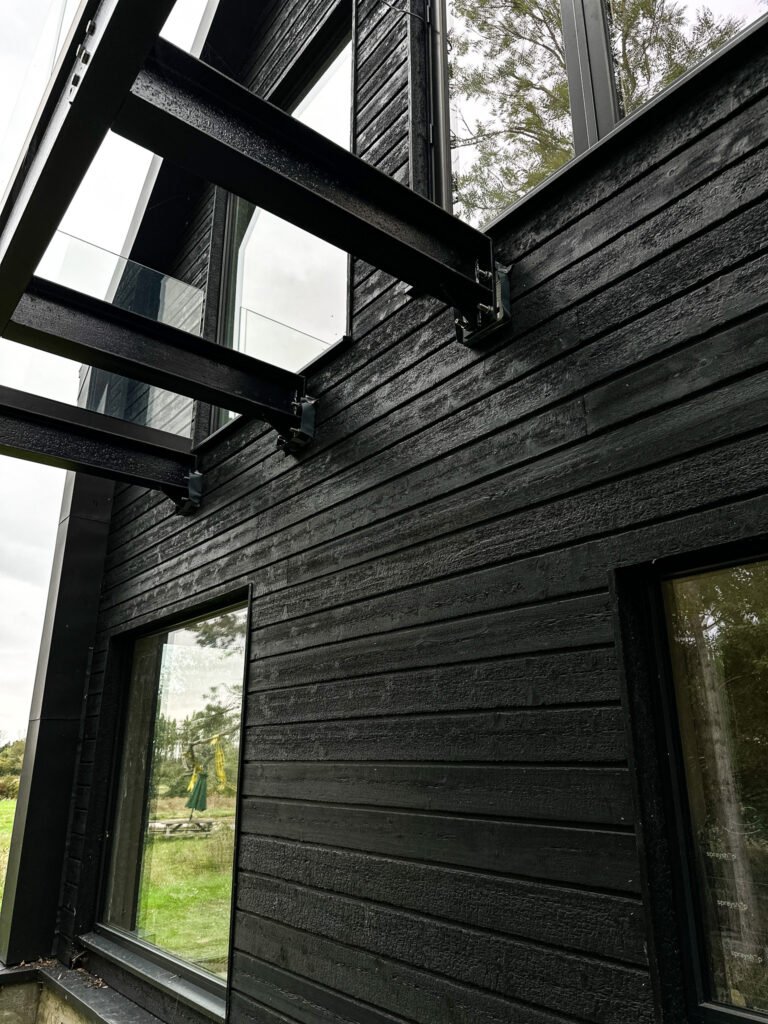
Construction of houses isn’t only about laying bricks and cement. It’s all about the creation of a sanctuary that speaks volumes about who you are and is connected with the nature around you. As you look at your external walls, you need to get a feeling of warmth, pride, and tranquility. That’s exactly the reason why a growing number of homeowners and architects choose natural timber instead of lifeless materials.
One of the most outstanding woods for this purpose is definitely larch wood. It’s robust, gorgeous, and highly reliable. Larch wood becomes especially impressive when subjected to fire – the result is known as charred wood. In this detailed guide, you will learn about the rich history, characteristics, and advantages of larch timber cladding.
What Exactly is Larch Wood Cladding?
Larch Timber Cladding is a type of wall covering using larch timber. Being one of the hardest and densest soft woods, it is valued for its great natural resistance to moisture and decay, and widely used as an eco-friendly material for constructing modern and classical buildings.
It has a wonderful combination of beautiful grain patterns and appealing colors that range from pale yellow to pinkish brown. It became an exclusive material for building modern structures in Western Europe and Larch Wood Nederlands due to its beautiful aging and good protection of houses.
Why Larch Cladding Is The Best Choice For Your Facade?
Selecting the proper material for your building can be really tricky. But Larch wood cladding provides you with a marvelous combination of poetic aesthetics and practical use. Let me give you several reasons for that.
Characteristics of Wood And Its Advantages
- Exceptional Longevity: Larch is one of the most durable kinds of softwood. High resin content makes it resistant to the influence of external factors.
- Appealing Appearance: The wood has tight, straight grain and warm colors, ranging from orange to red and dark knots.
- Resistant to Weather: Without treatment, larch wood becomes gray after several years with minimal maintenance needs.
- Environmentally Friendly: Larch comes from sustainably managed forests in Europe, Siberia, and the UK.
Popular Types
- Siberian Larch: Slowly grows under hard climatic conditions; therefore, the wood is exceptionally dense.
- European/British Larch: It grows relatively fast in home conditions. It is highly sustainable but has a tendency to form more knots and to move moisture, thus being more susceptible to deformation.
Popular Profile Styles
Larch boards are machine-shaped and profiled to have the right runoff and ventilation:
- Shiplap and Tongue and Groove: Interlocking profiles that provide a tight, weatherproof junction appropriate for contemporary homes.
- Feather/Waney Edge: To create a rustic look, thinly sliced and overlapped boards are used.
- Charred Larch: Using an age-old Japanese technique, this choice greatly increases the overall durability of your siding while producing a stunning, dark look through precise fire treatment that produces a robust layer of charred wood.
Points to Consider
- Wood movement: Larch is a “living” product that will expand and contract with changes in weather conditions. Professional installation with the right expansion joints and ventilation is necessary.
- Staining and bleeding: The high levels of resin within the wood can cause paint to bleed through the wood. It is important to use oils which are resistant to ultraviolet light to keep the gold color of wood.
A Proper Choice: Larch Wood and Shou Sugi Ba
Although larch wood is quite strong on its own, the true value of the material can only be seen in combination with a Japanese technology called Shou Sugi Ban (or Yakisugi), invented by Japanese carpenters in the 18th century. It includes burning the surface of the timber planks using fire.
Once you apply fire treatment to larch wood nederlands, magic begins. The fire burns off all cellulose sugars that are found at the surface of the material, leaving only the strong carbonized layer. At Bauwn, we have our own special charring chamber that allows us to do it just right. Thus, each and every board gets a perfect texture and black color.
Bringing Inspiration to Life
Charred timber is taking the design world by storm, from charming countryside cabins to ultra-minimalist city offices in Europe. The black color palette provides an impressive contrast against the glass walls, concrete, or steel facade.
At Bauwn, we have witnessed clients utilize larch wood cladding to transform simple structures into stunning pieces of architecture. It can be installed horizontally to give a structure a bigger look while making it appear lower to the ground or vertically for a towering effect. It is not only about the protection; it is about creating a welcoming and premium atmosphere that you will want to come back home to.
Final Thoughts
Every piece of architecture deserves material that would assure longevity and outstanding performance. At Bauwn, our skilled professionals are genuinely passionate about blending old-world techniques with modern technology to provide you with top-notch blackened facades. Browse through our extensive collection of sustainable and high-performance products, and connect with us today to get your custom quote or even order a sample box with tangible larch wood cladding samples. Contact our team today to learn more about larch wood nederlands and explore our premium timber solutions for your next project.
FAQs:-
1. What is the lifespan of larch timber cladding?
Larch timber cladding usually lasts 30 to 50 years and up to 60+ years when using high-density types of larch, such as Siberian Larch, under optimal conditions. The highest lifespan of larch timber cladding depends greatly on correct ventilation and the absence of ground moisture on the boards with stainless steel fixings.
2. Why do architects prefer larch wood Nederlands so much for their projects?
Architects who choose larch wood do so since it perfectly combines the features of sustainable local material, affordability, and high-quality strength structure. It is a very good choice for the minimalistic style that is typical for the modern Dutch architecture, which involves natural materials.
3. Does charred wood need lots of painting or staining?
No, charred wood (Shou Sugi Ban / Yakisugi) does not need lots of painting or staining. On the contrary, the Japanese technology uses a carbonization process to form the protective layer that protects timber from harmful UV radiation, rot, pests, and fire.
4. Can I use larch wood facades both outside and inside my building?
Yes, you can definitely use the larch wood as an outdoor siding and interior wall material. The wood is tough, durable, and flexible. But because of differences between indoor and outdoor climates, the larch should be installed using different techniques for each of the cases.
5. Is the burning process environmentally friendly and sustainable for our planet?
Yes, using Shou Sugi Ban on larch wood Nederlands is a highly eco-friendly option. The process relies purely on natural fire to strengthen the wood, eliminating the need for toxic chemical wood preservatives, and we only use healthy, water-based finishes to complete our premium wood products.